How to Get Rid of Air Bubbles in Baby's Bottle
Melissa has a bachelor's caste in geology, and is an ACI-certified concrete field and lab technician.
Significance and Use of ASTM C231
This examination'southward purpose is to get the air content of a sample of concrete using a pressure meter. In the meter you have a known volume of air at a known force per unit area in a sealed air pot with an unknown volume of air beingness contained inside the sample of moisture physical. You set it to the per centum of air (your initial pressure) where the pressure is equalized inside the chamber, fill information technology with concrete and water so that the simply air left is the air within the concrete, and then release the pressure inside of the air bedroom to get your apparent air content. The bodily air content is establish by subtracting the aggregate correction factor, which you can calculate using batch information and a test that is expanded on beneath, from the apparent air content.
Air content is very important to the project engineer. The amount of air can increase or subtract the forcefulness of the concrete, tin can decide whether the concrete is protected from freeze-thaw conditions or is prone to weathering, and can impact the cease and corrective look of the concrete. If y'all spend months planning out a edifice, you desire it to wait good! For every percent of entrained air that is added to the mix, the strength of the concrete goes downward near 200-300 psi. Cheque with whoever's in charge at the site to encounter the air content they need in their specifications and notify them if the results come out unusually high or depression.
This method is simply used for regular weight physical that has relatively dense aggregate. Lightweight concrete is typically done with the volumetric method (the infamous rollermeter) because the aggregate is too porous and the test results will be thrown off with so much entrapped air. Also, this test should not exist performed on whatever concrete with aggregate larger than ii". Large aggregate pieces should be sieved out before testing.
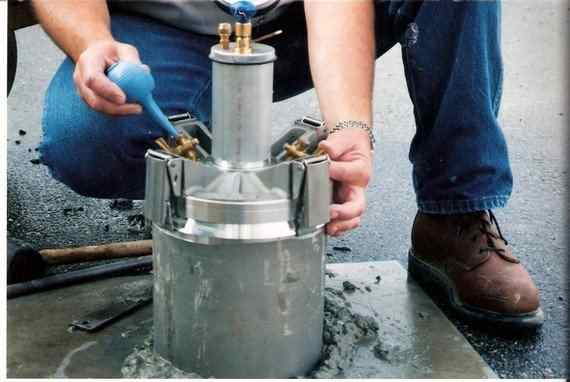
Air Content Test Equipment
- A clean, working pressure meter, complete with estimate and basin (come across calibration for more specifics)
- A tamping rod – the 18 inch, 5/8 bore rod (the big one used with 6x12 cylinders, not the small one used with 4x8s). Must have a polish hemispherical tip and be between 4 and 24 inches longer than the measuring bowl.
- A mallet – must weigh i.25 ± 0.fifty lbs for pressure level meters smaller than 0.5 ft³, and 2.25 ± 0.50 lbs for force per unit area meters larger than 0.v ft³.
- A strikeoff bar – must be at least one/8 inches thick and ¾ inches wide past 12 inches long.
- A h2o dropper – to fill the remaining space in the sleeping accommodation with water until water comes out of the valves. Fun fact: it's typically the same thing you would utilize to suck snot out of a baby's nose. I have also seen some techs use an empty ketchup bottle.
- Scoop – needs to be large enough to get a representative sample of concrete and small enough not to spill physical during placement in the measuring bowl.
- Rag or Sponge – for cleaning. Make sure you scrub the inside of the hat very well, because whatsoever physical left within tin can brand your life difficult afterwards.
- Bucket of water – also for cleaning. Annotation that concrete stuck to the inside of the sleeping accommodation tin can be dissolved with vinegar or a special liquid chosen backset if you come back from the field and there is some concrete you couldn't remove.
- A calculator – to get your aggregate correction factor
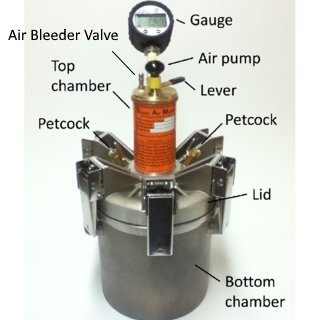
The parts of a type B pressure level meter.
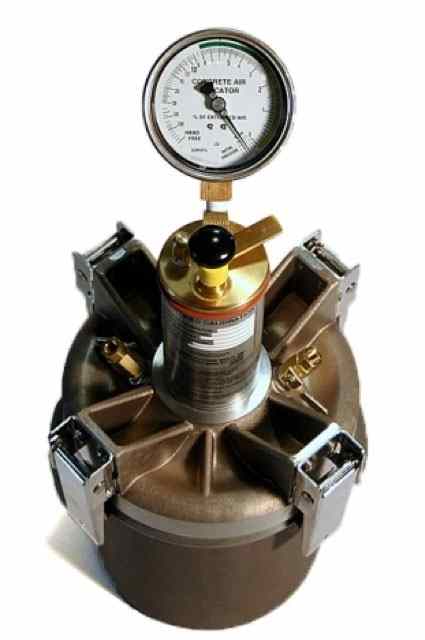
The judge must exist pumped to an initial pressure, which is beyond the nil mark.
ASTM C231 Procedure
- Wipe down the inside and rim of the measuring bowl and the cover with a wet rag to ensure that the pressure level meter seals correctly when information technology is closed. Brand sure yous are doing the test on a level surface away from moving vehicles.
- Take your sampled concrete (sampled according to ASTM C172) and mix information technology upwardly thoroughly. You will put in 3 layers of equal book, and use your tamping rod to strike 25 blows through each layer of concrete. Infinite out your blows over the surface of each layer, and know that each accident should penetrate the previous layer by about an inch. The bottom layer will be penetrated to the bottom. On the third layer you will want the physical to be slightly above the rim of the basin. Afterwards each layer is done, strike it 10-xv times with a mallet to get rid of air bubbles that could overinflate your air content value. I like to do it 12 times, 3 on each side of the bowl.
- Strike off the backlog concrete, placing your strike-off bar in the middle of the bowl and using a back and forth sawing motion to clear off the concrete. Motility it towards you while doing the sawing movement, then abroad, until in that location is a shine surface on meridian of the bowl at the level of the rim.
- Clean off the edges of the rim of the measuring bowl, then clench down the comprehend of the air meter. Make sure you take an air tight seal or the results of your examination will be invalid.
- Open up the petcocks on your air meter by pushing the levers into an upright position. Use the water dropper to squeeze h2o into one petcock until h2o squirts out the other end. Yous are filling it so the only air nowadays inside the meter is the air that's inside the concrete.
- Every air meter has its own calibrated initial pressure value. Pump air into the force per unit area meter until you lot have reached this line. You should pump a petty flake past it and utilise a combination of opening the bleeder valve (looks like a small knob, and you will hear air coming out when it is opened) and lightly borer the side of the guess until it is stabilized at the correct initial pressure. Remember that the initial pressure area is past the naught mark, then make sure you get by the zero when yous are pumping it.
- Close both petcocks or you're going to become a face full of physical when you release the pressure.
- Utilize the lever at the top to release the pressure in the measuring bowl, and hit the side of the bowl at the same time with your mallet. Lightly tap the side of the gauge with your finger and the side of the measuring bowl with your mallet until the pressure stabilizes.
- Read the air content value on the guess. This is the apparent air content. Yous will need to decrease the aggregate correction factor from this air content to find the true amount of air in the concrete.
- Carefully open up each petcock (go slowly or you will end upwards covered in pressurized concrete) and release the remaining air in the sleeping accommodation. Remove the cover and dump out the concrete in an area allowed by those in charge on the site. Exercise non reuse this concrete, because h2o has been added, irreversibly changing the mix blueprint. Make clean out the within of your air meter thoroughly.
A Video of the ASTM C231 Procedure
Aggregate Correction Factor
For every air test y'all practise, you lot will need to business relationship for the amount of air that is stored in the voids of the amass. Some concrete suppliers may give out the aggregate correction factor for each mix design they offer. Others may not have that data on paw, but there is a test to detect the aggregate correction factor. This exam is typically performed in laboratory conditions just may occasionally be performed out in the field.
To do information technology, you will need to run an air test on a sample of fine and coarse aggregate in the same proportions and moisture condition equally the concrete sample under examination. First, summate the mass of fine amass, Fs, and the mass of coarse aggregate, Cs.
You will then need to fill your measuring bowl 1/3 total of water, and place your Fs and Cs sized samples in later mixing them together. Add the mixture of aggregates in small scoops then yous don't get extra air trapped in there. Stir after each scoop. If any cream is created during this process, remove it. You desire the aggregate to be completely inundated, so if information technology is necessary add additional water until it is covered.
After each layer of amass yous add, you will as well need to rod the upper 1 inch of aggregate 8-12 times, and tap the sides of the bowl a few times. When you have all the aggregate added it will sit for a menstruation of time about equivalent to the time between water going into the mixer and the time of performing the air test.
Earlier you put the cover on, you will screw a straight tube into the bottom of i of the petcocks and a j-shaped tube into the pinnacle of that petcock. And so, you lot will practice your air content on that aggregate mixture, following the steps of the procedure in a higher place from footstep 4 onwards to the point where the air is released into the bowl, stride 8.
Read More than From Owlcation
Then, you volition remove water from the air meter and put it into your calibration vessel, by releasing water out of the J tube. The water in the calibration vessel represents the percentage of air in the aggregate that was entrapped and has now been removed.
The final aggregate correction factor is:
Calibration
Pressure meters need to be calibrated frequently. Nosotros calibrate ours every 3 months. Your lab technician will call you and tell y'all to bring it in, and the calibration process in Annex A-ane of the ASTM volition be performed. It volition exist helpful for you to read this annex as it tin help y'all troubleshoot problems with the pressure meter.
Common issues with air meters include:
- the bowl changing book due to physical buildup left over with improper cleaning
- the valves becoming clogged due to physical buildup (you will have trouble putting h2o in)
- the needle condign bent and existence unable to move due to touching the glass or the gauge itself
- the needle coming loose and offsetting the judge reading
- the gasket seal being popped (you will hear the sound of air whistling out of the gauge).
If whatever of these problems occur earlier calibration practice non hesitate to bring it in and accept your lab tech have a look. It is vital to get the correct air content on tests and unfortunately the pressure meter is one of the almost sensitive pieces of equipment. Please keep your force per unit area meter make clean, and check information technology over before every day of testing to make sure it is working properly. Take pride in your piece of work and keep your equipment clean and operating smoothly.
How to Calibrate a Type B Pressure Meter
ASTM C231 Quiz
For each question, choose the best respond. The answer central is below.
- What practice y'all exercise afterwards you pour water into the pressure meter?
- Pump air into the meter up to the initial pressure line
- Shut the petcocks
- Release the chief air valve
- What is entrained air?
- Air that occurs naturally in the physical.
- Air that is intentionally added to the mix
- Why can't this method be used with lightweight concrete?
- The aggregate is too porous
- Lightweight concrete has more entrained air
- It can be used with lightweight physical
- What is the maximum size aggregate permitted with the Blazon B pressure level meter?
- ii inches
- ii.five inches
- 3 inches
- Which of these is non a common trouble with air meters?
- the valves condign clogged due to concrete buildup
- the needle becoming loose and offsetting the gauge reading
- the air meter growing legs and walking away
- If the amass correction factor is 0.3% and the air content read on the gauge is iv%, what is the actual air content?
- 3.5
- 3.half dozen
- 3.7
Answer Key
- Pump air into the meter upwardly to the initial pressure line
- Air that is intentionally added to the mix
- The aggregate is too porous
- 2 inches
- the air meter growing legs and walking away
- iii.vii
Questions & Answers
Question: What is the book of a standard air pot?
Answer: The standard type B air meter, when new and unused, should have a volume of 0.250 cubic feet.
© 2018 Melissa Clason
Hamid Hamdard on January 13, 2020:
in Type B air meter,the reading of pressure gauge was 5% and how tin can fine aggregate correction Factor
Mehar zeb on November 23, 2019:
in Type B air meter, the reading of pressure gauge was iv.7 % and aggregate correction
gene is 0.76, the apparent air content is:
Source: https://owlcation.com/academia/ASTM-C231-Testing-Air-Content-With-a-Type-B-Pressure-Meter
0 Response to "How to Get Rid of Air Bubbles in Baby's Bottle"
Post a Comment